
The short answer: seal before the first cold front
Fall rodent-proofing in Tulsa means closing every gap a pencil fits into, before the first real cold front of the season sends mice looking for a warm wall. That is usually late September into October here. Not November. By November the ones that wanted in are already in.
The job is less about poison and traps than people think. It is a flashlight, a putty knife, a bag of steel wool and one honest lap around the house. Most Green Country homes have somewhere between three and a dozen openings a mouse can use, and nearly all of them sit where you rarely look: the bottom corners of the garage door, the dryer vent, the spot where the AC line set goes through the brick.
What a mouse does with one quiet winter in your house
A house mouse that gets in during October has four or five cold months in a warm, dark, food-adjacent space, and it does not waste them. Here is what that looks like when nobody notices for a while.
It is a Tuesday in January. The heat is running, the house is quiet, and you are asleep. Above the bedroom ceiling, in blown-in insulation that nobody has looked at since the inspection, a nest the size of a softball is warm from the bodies inside it. Mice gnaw constantly because their front teeth never stop growing, and the wire running along that joist has a soft plastic jacket. One chews it back to bright copper. Then another does the next few inches.
You hear it, eventually. A dry scratching right over your head around 2 a.m., gone the moment you sit up. You tell yourself it is the house settling. It is not the house.

By spring there are droppings in the silverware drawer, a sour ammonia smell in the pantry corner, and a nest of shredded insulation to clean up with gloves and bleach. None of that is exotic. It is the standard ending to a winter where a quarter-inch gap stayed open, and it is why the sealing is worth a Saturday in October.
The gaps mice actually use on a Tulsa house
Mice use the small, boring gaps, because the CDC says a mouse can fit through a hole the width of a pencil, about a quarter inch. If you can slide a pencil in, a mouse can follow it. Keep that test in your pocket and the walk-around gets easy.
On Tulsa-area brick ranches and newer slab builds in Broken Arrow or Owasso, these are the usual suspects, roughly in the order we would check them:
| Where to look | What the gap looks like | What seals it |
|---|---|---|
| Garage door bottom corners | Daylight at the ends where the rubber seal lifts off the slab | New bottom seal, plus corner seal pads |
| Dryer vent hood | Flapper stuck open or missing, a warm tunnel straight into the laundry | Replace the hood with a working damper, never screen it shut |
| AC line set, gas and water entries | Oversized hole around pipes, old caulk cracked away | Steel wool packed in, caulk over it |
| Weep holes and brick-to-siding joints | Open mortar joints low on the brick, gaps where brick meets trim | Weep screens or mesh inserts that still let water drain |
| Crawl space and foundation vents | Torn or rusted screen, a vent cover knocked loose by the mower | Hardware cloth screwed in place |
| Soffits, eaves and roof returns | Gap where the soffit meets the fascia or the roofline changes | Metal flashing or hardware cloth |
| Exterior door thresholds | Light under the back door or the door to the garage | A real door sweep that touches the threshold |
Weep holes deserve a warning: brick veneer needs them to drain, so never mortar them shut. Use inserts made for the job.
Your October walk-around, step by step
DIY rodent-proofing works when you use materials a mouse cannot chew, and the CDC is specific about them: steel wool held in with caulk or spray foam for small holes, and lath screen, metal, cement, hardware cloth or metal sheeting for larger ones. Here is the order that saves you backtracking.
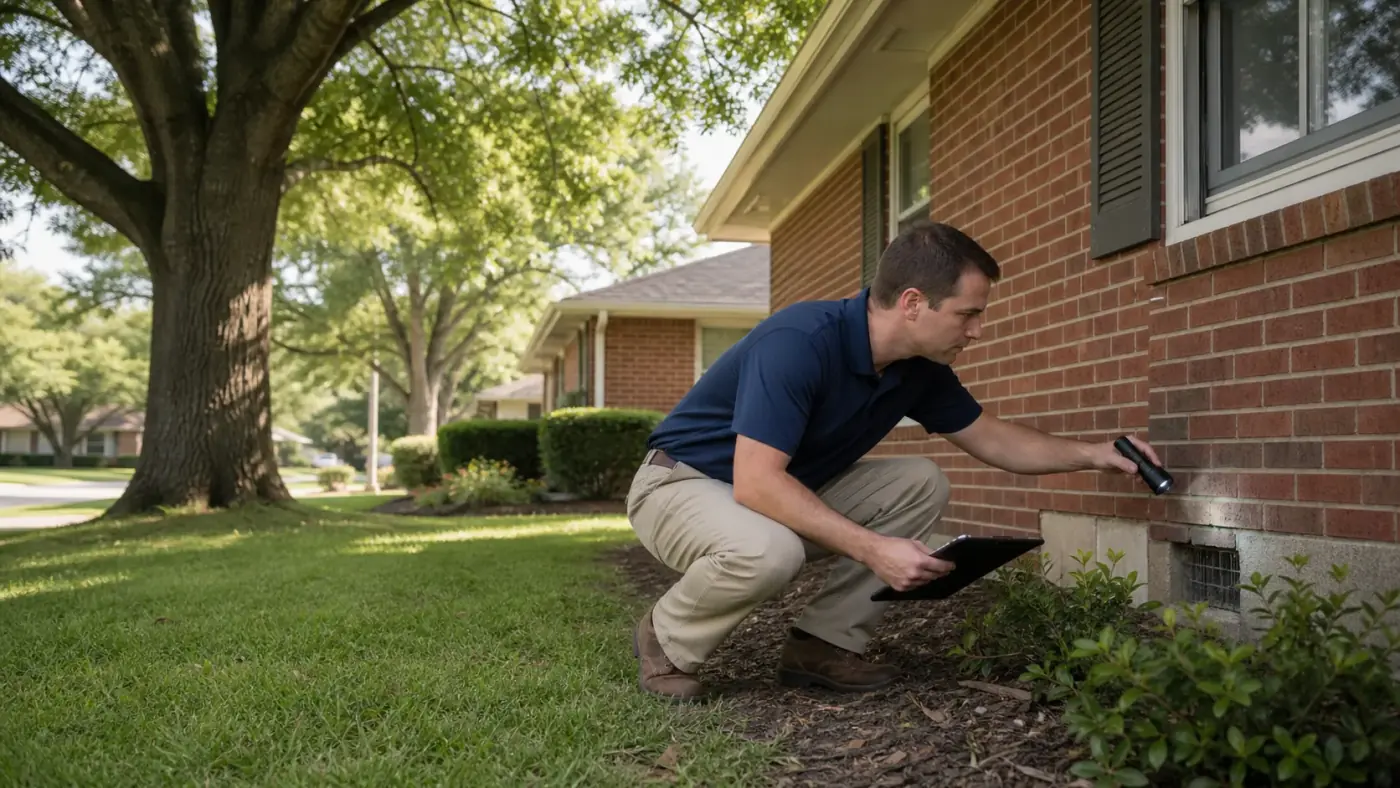
- Go out at dusk with a flashlight. Walk the foundation slowly and aim the light low and sideways along the brick. Gaps throw shadows that daylight hides.
- Then do it from inside the garage with the lights off. Any daylight leaking around the door or the wall plate is an entry.
- Pack, then cap. Stuff steel wool or copper mesh hard into every pipe gap and seal over it with caulk or foam. Foam on its own is a snack, not a seal.
- Fix the doors. A new garage door bottom seal and a sweep on the door into the house close the two busiest routes on most Tulsa homes.
- Cut the bridges. Trim limbs back from the roof and pull ivy off the brick. Mice climb better than you would think.
- Move the buffet. Birdseed and dog food go into metal or heavy plastic bins with lids. Firewood gets stacked off the ground and away from the wall.
- Set a few snap traps as a smoke alarm. Put them along walls in the garage, behind the washer and in the pantry. If nothing touches them in two weeks, your sealing probably worked.
One cleanup rule matters for your lungs. The CDC says not to sweep or vacuum droppings, because it can put tiny droplets containing viruses into the air. Gloves on, spray with a fresh mix of 1 part bleach to 9 parts water, let it soak 5 minutes, then wipe it up with paper towels.

When DIY is not enough: five signs
A Tulsa house is past DIY rodent-proofing once the mice are living inside rather than trying to get in, and these five signs say so plainly.
- Noise in the ceiling or walls at night, especially scratching overhead that comes back on a schedule.
- Fresh droppings a week after you sealed, which means they were already in and you may have closed them inside.
- Chewed wiring, torn ductwork or tunnels in attic insulation. That is structural damage, and wiring belongs to an electrician after the rodents are handled.
- Gaps you cannot reach safely, such as a two-story roofline, a soffit over a steep pitch or a crawl space you cannot turn around in.
- Bigger droppings or gnaw marks, the kind that point to rats rather than mice. Rats need their own trapping plan.
If two of those sound like your house, call (844) 212-9836 and describe what you are hearing and where. We connect you with a licensed local provider who works your part of Green Country, one who does the exclusion work alongside the trapping, so the job actually ends. It is a short, free call, and you will know whether this is a one-visit fix or a bigger project before anyone climbs a ladder.
After the sealing: keeping it that way
A sealed Tulsa house stays sealed with about ten minutes of checking each fall, because seals wear, dryer flaps stick and the garage door gets bumped. Put it on the calendar for the first cool weekend.
If a pro handles it, expect exclusion work to be priced separately from trapping. Typical market ranges, not a quote, run about $300 to $1,500 for sealing, depending on the roofline and how much of the foundation needs attention. Our Tulsa pest control cost guide lays out the rest of the numbers, and the rodent control page explains how a full trap-and-seal program runs. If the noise overhead turns out to be something bigger than a mouse, wildlife removal is its own job.
Most people who seal in early October never deal with a mouse that winter. It is one of the few pest jobs where a single Saturday of attention buys you a quiet house until spring.
How the call works
- Describe the problem. A recluse in a shoe, termite swarmers on a window sill, ticks coming in on the dog. A sentence or two is plenty.
- Get routed by ZIP code. The call lands with an independent, licensed company that already services your neighborhood, whether that is midtown Tulsa or Claremore.
- Set the appointment. Most companies can give you an inspection or treatment window before you hang up.
Whether a same-day or 24/7 visit is possible comes down to provider participation in your area, technician availability and demand on that day. It is never guaranteed, and open slots vary by market and by how full the schedule already is.
Frequently asked questions
When should you rodent-proof a house in Tulsa?
Rodent-proofing a Tulsa house is best done in late September or early October, before the first real cold front of fall. House mice move toward warm structures as nights cool, so sealing after they are already nesting in the attic means you are locking some of them inside. A weekend of sealing before that first cold snap does more than a month of trapping after it.
What should you use to seal mouse holes?
Seal mouse holes with materials rodents cannot chew. The CDC recommends steel wool held in place with caulk or spray foam for small holes, and lath screen, lath metal, cement, hardware cloth or metal sheeting for larger ones. Spray foam alone is not a seal, because a mouse chews through it in an evening.
Is it safe to sweep up mouse droppings?
Sweeping or vacuuming mouse droppings is not safe, because the CDC warns it can put tiny droplets containing viruses into the air. Wear rubber or plastic gloves, spray droppings and nesting material with a fresh mix of 1 part bleach to 9 parts water until very wet, let it soak 5 minutes, then wipe up with paper towels.