

Why Green Country grows so many ticks
Northeastern Oklahoma grows ticks the way the Panhandle never will: wooded creek bottoms, brushy fence lines, deep leaf litter, deer, and summer humidity that keeps a questing tick from drying out. Oklahoma State University Extension names the lone star as the tick most commonly encountered by people during recreation in Oklahoma, and it feeds on humans at every stage of its life. Lone star larvae are what Oklahomans call seed ticks, and OSU Extension notes they quest in a clustered mass. One step near a brush pile puts forty on your socks instead of one.
Ticks also do not live in the middle of a sunny mowed lawn. They live in the shaded strip where the mowing stops and the trees, ivy or fence line begins. A Jenks yard backing onto a greenbelt has a tick problem in one specific place.
The three ticks you will actually meet here
Three species account for nearly every tick bite around Tulsa: the lone star tick, the American dog tick and the blacklegged tick. The Oklahoma Center for Poison and Drug Information lists exactly those three as Oklahoma's ticks, and each carries a different set of problems.
| Tick | How you know it | What it can carry | When it is out |
|---|---|---|---|
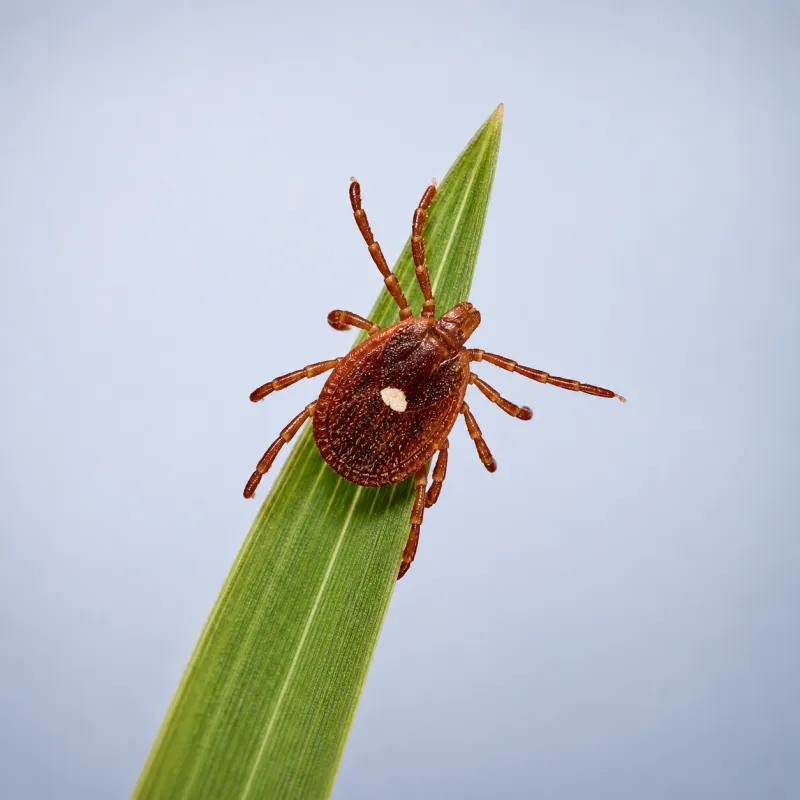
| Lone star tick | One white dot on the adult female. CDC calls it a very aggressive human biter | Ehrlichiosis, tularemia, Heartland virus, the STARI rash, and per CDC the growing evidence for alpha-gal syndrome | Early spring to late fall |
| American dog tick | Larger, gray and white mottling over brown | Rocky Mountain spotted fever, its only known Oklahoma vector per OSU Extension, plus tularemia and ehrlichiosis | Spring and early summer |
| Blacklegged tick | Small, dark unmarked legs, no body pattern | Anaplasmosis, babesiosis and Lyme disease, though Lyme is rare here | Adults late September through March |
The blacklegged tick surprises people. OSU Extension explains that Oklahoma's immature blacklegged ticks feed on lizards rather than on the mice that carry the Lyme bacterium, and reported Oklahoma Lyme incidence averaged under 0.7 cases per 100,000 from 1992 to 2006. Spotted fever is the one to respect instead. OSU Extension calls it Oklahoma's most important tick-borne disease and notes that this state and North Carolina together account for more than a third of the nation's cases each year, peaking here in May, June and July.
When Oklahoma's tick season starts and stops
Tick season in Oklahoma runs early spring to late fall, and the dangerous stretch is April through September. CDC puts peak national tick activity in those same warmer months, and Oklahoma's spotted fever cases cluster April to September.
Winter is quieter, not empty. CDC notes adult blacklegged ticks hunt whenever winter temperatures climb above freezing, which in Tulsa is most of January. Seasonal programs here start in March and run into October, which is why tick and mosquito control get sold together. Both hit the same shaded, humid zone.
Turning the yard edge against them
The highest-value tick work on a Tulsa property happens in the last three feet of lawn before the trees start. CDC's tick-safe zone checklist, which OSU Extension reprints for Oklahoma homeowners, is unglamorous and it works:
- Remove leaf litter, and clear tall grass and brush along lawn edges.
- Lay a wood chip or gravel barrier at least three feet wide between lawn and woods.
- Mow often. Ticks need height and shade to quest from.
- Stack firewood neatly and off the ground in a dry spot, which CDC notes also discourages rodents.
- Move swing sets, decks and patios away from yard edges and trees.
- Fence out deer, and haul off the old furniture pile ticks hide under.
A licensed local company then treats the wooded edge, fence lines, ground cover and shrub beds rather than blanketing the open lawn, and two or three timed applications beat one heavy spray in June. CDC is blunt that pesticide reduces ticks in treated areas but should not be relied on by itself. Ask about rodent bait boxes too: OSU Extension says boxes that treat wild rodents with an acaricide have been shown, used properly, to cut ticks around homes by more than 50 percent.

The dog is the delivery system
Most ticks that reach a Tulsa living room floor arrived on a dog. CDC is direct about it: ticks ride in on pets and clothing, then attach to a person later, so pets and daypacks need checking every time they come inside.
Get the preventive from your veterinarian, then still run your hands over the dog: ears, armpits, between the toes, under the collar. The product handles the tick that bites the dog, not the hitchhiker that drops onto your rug. Brushy yards produce fleas too, so flea control often rides on the same visit.
Getting a tick off without making it worse
Pull it straight out with fine-tipped tweezers gripped as close to the skin as possible, and do it now instead of driving to a clinic. CDC's method: grasp close to the skin's surface, pull away with steady even pressure without twisting or jerking, seal the tick in tape or a container, then clean the bite and your hands.
What not to do matters as much. CDC says plainly not to use petroleum jelly, heat or nail polish to make a tick back out, because that can agitate it and push infected fluid into the skin. The Oklahoma State Department of Health adds matches, gasoline and ointments, and warns against squeezing the body. If mouthparts break off and will not lift out, leave them. For the full routine, from the pull itself to the dryer and shower habits that stop the next tick, see our guide to tick removal and prevention in Oklahoma.
When to call a doctor: CDC says see your doctor if a rash or fever appears within several weeks of removing a tick, and to mention the bite. The Oklahoma Center for Poison and Drug Information is sharper for this state: if you become ill within a week of a tick bite, call a physician right away. Spotted fever usually starts three to 14 days after the bite with sudden fever, chills, muscle aches and headache, and OSU Extension notes it responds well when caught early. The poison center answers around the clock at 1-800-222-1222.
What tick work costs around Tulsa
Seasonal yard tick programs in this market usually land in the ranges below. These are typical Tulsa ranges, not quotes, and the company you are connected with prices the property after seeing how much wooded edge it has.
| Service | Typical Tulsa range |
|---|---|
| One-time yard tick treatment | Roughly $100 to $200 |
| Seasonal tick program, per visit | Roughly $60 to $110 |
| Tick and mosquito program, per visit | Roughly $70 to $130 |
| Rodent bait boxes, per season | Roughly $300 to $600 by box count |
| Wooded acreage or greenbelt lots | Per acre, often $150 and up per visit |
Lot size barely moves that number. Linear feet of woodland edge does. A fenced half acre in Owasso with no trees costs almost nothing; a quarter acre in south Tulsa backing onto a creek costs more than its size suggests.
Every pest control business and applicator in Oklahoma is licensed through the Oklahoma Department of Agriculture, Food and Forestry, whose Consumer Protection Services handles applicator certification and business licensing. Ask for the license number, then ask which parts of the property get treated, how many visits the season includes, and whether bait boxes are offered. Calls route by ZIP code to an independent licensed company covering your address. Start with the full service list if ticks are not the only problem.
How the call works
- Describe the problem. A recluse in a shoe, termite swarmers on a window sill, ticks coming in on the dog. A sentence or two is plenty.
- Get routed by ZIP code. The call lands with an independent, licensed company that already services your neighborhood, whether that is midtown Tulsa or Claremore.
- Set the appointment. Most companies can give you an inspection or treatment window before you hang up.
Whether a same-day or 24/7 visit is possible comes down to provider participation in your area, technician availability and demand on that day. It is never guaranteed, and open slots vary by market and by how full the schedule already is.
Frequently asked questions
Does a mosquito treatment also take care of ticks?
Partly, because both target the same shaded, brushy edge of a yard, but they are not the same job. Tick work concentrates at ground level: leaf litter, ground cover, fence lines and the woodland edge. Mosquito work targets resting sites in foliage and standing water. Ask whether the plan covers both.
Will one spray get rid of ticks for the whole summer?
No. CDC states that pesticide reduces tick numbers in treated areas but that spraying alone should not be relied on to prevent infection. Oklahoma's season runs early spring to late fall, so one June application leaves months uncovered. Local programs use several timed treatments plus landscaping that removes the habitat.
Can I catch Lyme disease from a tick in Tulsa?
It is very unlikely. Oklahoma State University Extension explains that the blacklegged tick lives here, but its larvae and nymphs feed on lizards rather than the mice that carry the Lyme bacterium, and reported Oklahoma incidence averaged under 0.7 cases per 100,000 from 1992 to 2006. Spotted fever and ehrlichiosis are the real concerns.
How long must a tick be attached to transmit disease?
Several days, in most cases. OSU Extension states that ticks must be attached and feeding for several days to transmit the organisms that cause disease, and that a crawling, unattached tick transmits nothing and brushes off. That is the argument for a daily tick check and the shower within two hours CDC recommends.