
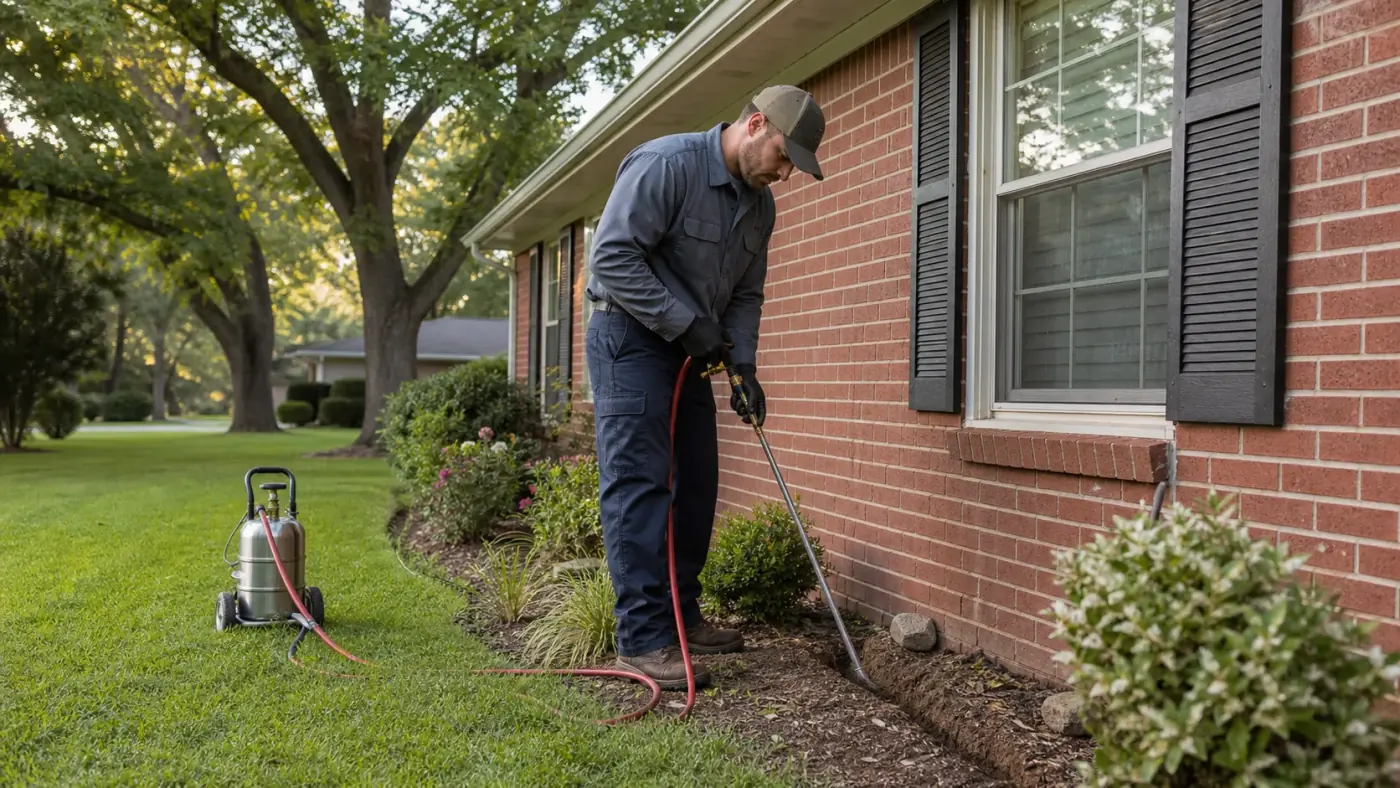
March through May is how most Tulsa homes find out
March, April and May are the normal flight months for subterranean termites in Oklahoma, says Oklahoma State University Extension, and that flight is how most Tulsa homeowners learn a colony has been under the house for years. Warm weather plus rain sets it off, so swarms arrive on a still, muggy afternoon a day or two after a spring storm. A smaller fall flight in September or October is real but far less consistent.
A swarmer runs two fifths to half an inch long with wings, dark brown to black, and flies badly. It drops, sheds all four wings, and hunts for soil. So the evidence outlasts the insect: a scatter of identical clear wings on a sill, no live termite in sight. Save a few in a sandwich bag. An inspector reads them better than a phone photo. If the wings are on your sill right now, our guide to what termite swarm season in Oklahoma means for your house covers that first afternoon step by step.
Swarmers outside versus swarmers inside. Termites live in soil throughout Oklahoma, so winged termites out in the yard, over a stump or around a woodpile are normal and do not mean your house is infested. Indoors is a different matter. Oklahoma State University Extension puts it plainly: swarmers found inside make an infestation almost certain, unless a door stood open. Swarmers emerging at the foundation line or out of an attached porch slab are nearly as telling.
What to look for the other eleven months
Mud tubes are the sign that shows up between swarms. Subterranean termites need humidity, so they build earthen tubes about the diameter of a pencil up foundation walls, brick, piers and floor joists. Break one open. Creamy-white workers with pale orange heads inside means the infestation is active. An empty tube proves nothing either way, since colonies abandon stretches of tube while foraging elsewhere in the same house.
The rest of the evidence is quieter. OSU Extension points to high-humidity spots as the likeliest place to find damage: under the kitchen sink, under bathroom sinks, at the bath trap, anywhere water lines run in a wall. Damaged wood is hollowed along the grain with dried soil packed into the galleries, exactly what carpenter ant damage never looks like. Two more tells:
- Pinhole openings through drywall or plaster with a smudge of soil around the rim.
- Rippled or blistered paint on a baseboard where termites are tunneling just underneath.

Termite swarmer or flying ant? Three features settle it
Ants swarm in the same spring weeks and get mistaken for termites constantly, which is why the OSU diagnostic lab fields a wave of identification calls every March. Three features separate them, all checkable with a phone.
- Antennae. A termite antenna is straight and beaded, like a tiny string of pearls. An ant antenna bends sharply about halfway along, like an elbow.
- Wings. All four termite wings are close to the same size and shape and extend well past the tip of the abdomen. An ant's front wings are clearly longer than the hind pair.
- Waist. A termite is a straight tube, its waist as wide as the thorax it joins. An ant has an obvious pinch between thorax and abdomen.
Volume cross-checks it. A subterranean swarm usually numbers many thousands of flyers, so a handful of winged insects on a sill points toward an ant problem, the cheaper service by far. Drywood termites are not native here: OSU Extension calls them hitch-hikers riding in on furniture and firewood, and they build no mud tubes.
Why Green Country soil keeps the pressure on
Termites occur in every Oklahoma county, and Oklahoma State University Extension rates the risk very heavy in the southeastern counties and moderate to heavy across the rest. Tulsa sits in that band. The blunter line from the same fact sheet: attack can begin within a year of construction, because termites are already everywhere in Oklahoma soil.
That lands hardest in Owasso, Bixby and Jenks. A five-year-old house on a slab is not too new to have termites. It is too new for anyone to have looked. The soil is no help. The Dennis series that USDA soil scientists mapped across Tulsa and Rogers counties, type site just north of Claremore, averages 37 to 60 percent clay in its subsoil. Clay that heavy holds water against a footing after a storm, then cracks when August dries it out, which is why the state form counts wood resting on a cracked slab as a condition conducive to infestation.
Housing stock decides the work. A midtown home on pier and beam hands termites piers, a crawl space and a sill plate. A slab home hands them plumbing penetrations and hairline cracks, then hides the attack under four inches of concrete.
Liquid barrier, bait stations, or a spot job
Two approaches genuinely protect a Tulsa house: a continuous liquid termiticide barrier in the soil, or a monitored bait station system. A spot treatment is neither. A liquid job means a trench six to eight inches wide and deep against the outside of the foundation, drilling and injecting the patios and garage floors that abut the house, and treating the void behind brick veneer. On pier and beam, add trenches around every pier and utility pipe. Slab drill holes go no further than twelve inches apart, because a gap in the barrier is the failure mode.
Baits run on a different clock. Stations go into augered holes a foot or two from the foundation at ten to fifteen foot intervals, and termites have to wander in on their own. Once the colony is gone no residual product stays in the soil, so the monitoring contract is the protection.
| Approach | What happens at the house | Time to control | Warranty reality |
|---|---|---|---|
| Liquid termiticide barrier | Trenching, rodding, drilling adjacent concrete, veneer voids, interior work where activity shows | Fast, often weeks | Retreat warranty with an annual renewal; labels claim five years or more of control |
| Bait station system | Stations augered around the whole perimeter, then monitored and rebaited | Two to six months, sometimes longer | Warranted only while monitoring continues |
| Spot treatment | Drill and inject one infested area only | Immediate there, no protection elsewhere | Most reputable companies will not warrant it |
What a termite inspection covers in Oklahoma
An inspection tied to a property sale in Oklahoma must be written on the ODAFF 1 form, the Oklahoma Official Termite and Wood Destroying Insect Report. A company simply bidding treatment may use its own paperwork. The state form runs five pages and demands more than a verdict:
- Construction type. Stem wall material, floor type, crawl space or basement, exterior including brick veneer, pier type.
- What could not be seen. Unfloored attic, tight crawl space, hollow walls, locked storage, anything behind stoves, cabinets, insulation or floor coverings.
- Conditions conducive. Wood to ground contact, leftover form boards, moisture, debris, wood on a cracked slab, a woodpile against the wall, shrubs into the siding.
- Evidence. Live termites, tubes, frass, winged adults, exit holes, damage, previous treatment or an existing bait system, each plotted by symbol on a house diagram.
The report excludes wood-decay fungi and mold, so a clean termite report is not a clean moisture report. The notice of inspection gets posted at the breaker box, the water heater, under the kitchen sink or at the bath trap. Buying a Tulsa house? Go look at those four spots. Decades of treatment history are often stapled right there.
What termite treatment in Tulsa costs, and the warranty underneath it
These are ranges commonly seen across the Tulsa metro, not quotes. Linear footage, foundation type and drilled concrete move the number more than anything else.
- Termite inspection on its own: roughly $75 to $150, frequently waived when a company is bidding treatment.
- ODAFF 1 report for a closing: roughly $75 to $175.
- Full liquid barrier, average Tulsa home: roughly $900 to $2,200.
- Bait system installed, first year: roughly $1,000 to $2,500.
- Annual renewal: roughly $150 to $350 on a liquid job, $300 to $600 on a bait program.
- Spot treatment of a single area: roughly $300 to $800.
Oklahoma State University Extension states the warranty question about as directly as an extension service ever does: a warranty is a guarantee of service, not a guarantee of an effective termite barrier. Retreat warranties, which most Tulsa contracts are, mean the company returns and treats again free while the renewal is current. Repair warranties add an obligation to fix new damage, carry a dollar cap and exclusions, and cost more. Expect none where a well, a sub-slab heat duct or an uncrawlable crawl space blocks a to-standard treatment.
Oklahoma rules also require a written disclosure statement before any termiticide goes down: a sketch of the structure, the pesticide name and its label, and full warranty terms including excluded areas, period, renewal costs and what voids it. The Tulsa termite cost guide takes two quotes apart line by line, and the main pest control page covers the rest.
How the call works
- Describe the problem. A recluse in a shoe, termite swarmers on a window sill, ticks coming in on the dog. A sentence or two is plenty.
- Get routed by ZIP code. The call lands with an independent, licensed company that already services your neighborhood, whether that is midtown Tulsa or Claremore.
- Set the appointment. Most companies can give you an inspection or treatment window before you hang up.
Whether a same-day or 24/7 visit is possible comes down to provider participation in your area, technician availability and demand on that day. It is never guaranteed, and open slots vary by market and by how full the schedule already is.
Frequently asked questions
When do termites swarm in Tulsa?
March, April and May are the normal swarming months for subterranean termites in Oklahoma according to Oklahoma State University Extension, with flights usually set off by warm weather and rain. A smaller, less reliable flight can happen in September or October. Swarmers are two fifths to half an inch long, shed their wings within minutes of landing, and leave piles of clear wings on window sills.
I saw winged termites in the yard but not indoors. Do I need treatment?
Not automatically. Termites live in Oklahoma soil everywhere, so swarmers over a stump, a woodpile or open lawn are normal and do not prove the house is infested. They do prove an active colony is on your property. Swarmers coming out indoors, or emerging right at the foundation or from an attached porch slab, are a much stronger signal and warrant a full inspection.
Is a bait system better than a liquid treatment in Oklahoma?
Neither wins outright. A liquid barrier works faster and suits most Tulsa homes. Baits earn their place when a liquid job cannot be done to standard, such as an inaccessible crawl space, a well, sub-slab heat ducts, expensive floor coverings, or a house that failed a soil treatment before. Baits take two to six months to control a colony and protect only while monitoring continues.
Does a termite warranty pay to repair the damage?
Usually not. Most Tulsa contracts are retreat warranties, meaning the company returns and treats again free while the annual renewal is current, but pays nothing toward repairs. Repair warranties exist, cost more, and carry dollar caps and exclusions. Oklahoma rules require the company to disclose in writing whether its obligation is to retreat, to repair, or both before treatment begins.