
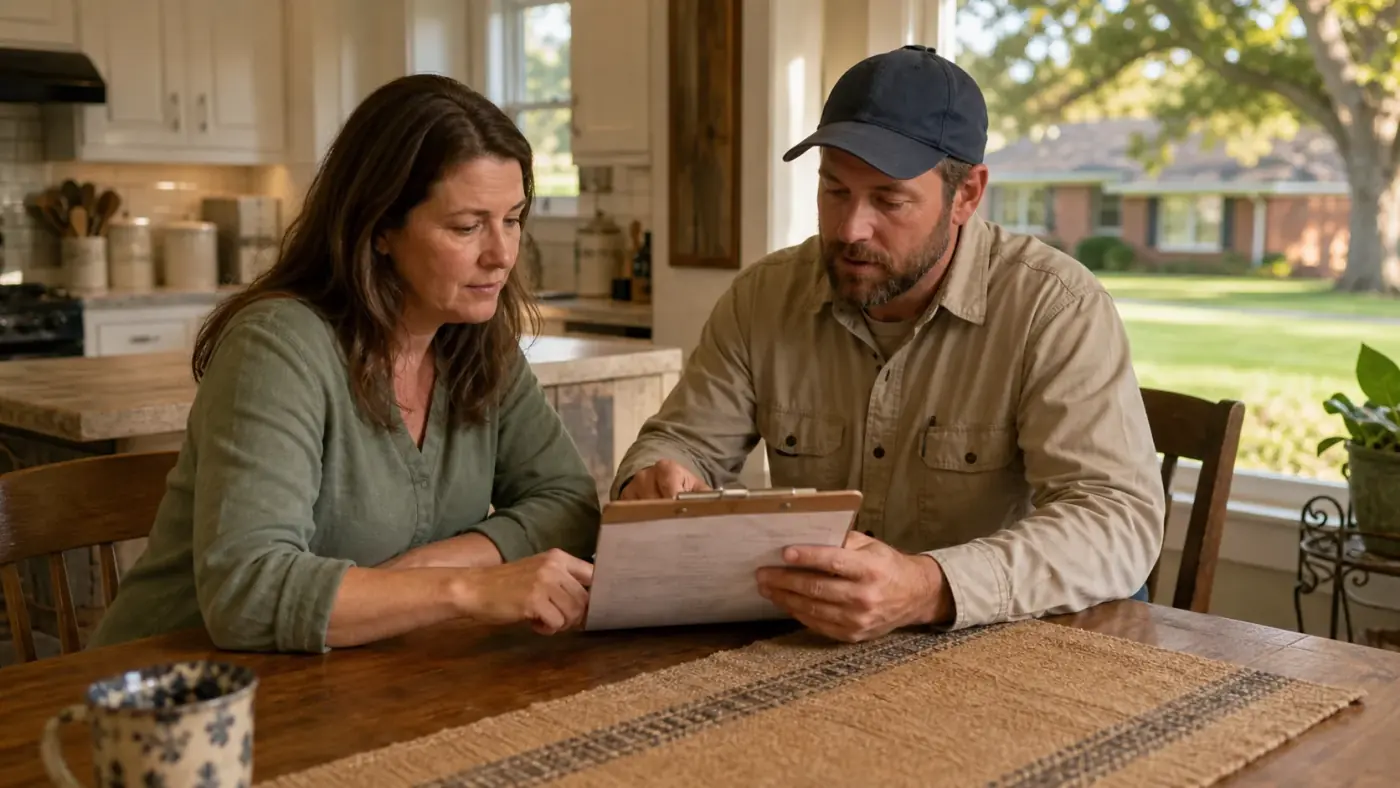
What termite treatment costs in Tulsa, by method
Method sets the ballpark, and there are four honest ones here. A full liquid barrier is the default for a Tulsa home. Bait stations cost more across five years and get chosen for reasons other than price. Spot treatment is the cheap answer to the wrong question.
| Method | What the price buys | Typical Tulsa range | Year two onward |
|---|---|---|---|
| Liquid termiticide barrier | Full perimeter trench and rod, drilling adjacent concrete, veneer voids, interior work where activity is found | $900 to $2,200 | $150 to $350 renewal |
| Bait station system | Stations around the whole perimeter plus scheduled monitoring and rebaiting | $1,000 to $2,500 first year | $300 to $600 monitoring |
| Liquid plus bait | Barrier where it can be applied, stations where it cannot | $1,800 to $3,500 | $350 to $700 |
| Spot treatment | Drill and inject one infested area | $300 to $800 | Usually no warranty at all |
Pre-construction soil treatment is priced by the square foot of slab and folded into the builder's contract, which is why buyers in Owasso and Bixby rarely see it as a line item. Ask anyway. OSU Extension notes termite attack can begin within a year of construction. See how each method works if the terms are new. Not yet sure the bugs on your window sill were termites at all? Start with what a spring termite swarm in Oklahoma actually tells you, then come back to the numbers.
Why the bid is really priced by the linear foot
A liquid termiticide bid is labor and chemical measured along the outside of your foundation, so the honest unit is the linear foot, not the square foot of the house. Tulsa bids typically work out to $6 to $12 per linear foot. Anything far outside that band deserves an explanation, in either direction.
This is where two houses of identical size come back with different numbers. A two-story stacks its square footage on a small footprint and has less perimeter to treat. A sprawling one-story of the same size has more, plus more patio and garage slab against it.
| Home | Rough foundation perimeter | Typical Tulsa liquid barrier |
|---|---|---|
| 1,200 sq ft ranch | about 140 linear feet | $850 to $1,700 |
| 1,800 sq ft ranch | about 170 linear feet | $1,000 to $2,050 |
| 2,400 sq ft two-story | about 160 linear feet | $950 to $1,900 |
| 2,400 sq ft one-story | about 200 linear feet | $1,200 to $2,400 |
| Attached garage, patio or addition | add 30 to 60 linear feet | add $180 to $720 |
Ask every company for the linear footage it measured. If two bids disagree by forty feet on the same house, someone is planning to skip a wall.
The five things that actually move your number
Foundation type is the biggest single driver and it is not negotiable. On a slab, Oklahoma State University Extension describes three separate operations: treating the soil under the slab including abutting porches and patios, trenching the outside perimeter, and drilling the void behind the veneer. Slab drill holes go no more than twelve inches apart. On pier and beam, the crew trenches around every pier and utility pipe under the house plus both sides of the foundation walls, which is slower than it sounds. Basements are rare here and add interior work.
- Concrete against the house. Patios, walkways, breezeways and garage floors touching the foundation have to be drilled, injected and patched. A wraparound patio can add several hundred dollars on its own.
- Brick veneer. The void behind it gets drilled and treated. Nearly every Tulsa ranch is brick, so this is standard work, not an upsell.
- Additions. A sunroom poured on its own slab is a second perimeter with its own joint to the original.
- Access problems. A well, a drainage system, a sub-slab heat duct or an uncrawlable crawl space can make a to-standard liquid job impossible. That pushes the quote toward baits and can void the warranty.
- Live activity inside. If the inspection finds termites indoors, the soil beneath the slab in that area must be treated too, often by drilling at an angle from outside to reach a kitchen or bath.
Inspection fees, and when the inspection is free
A standalone termite inspection in Tulsa runs roughly $75 to $150, and a company bidding treatment will usually waive it. That free inspection is a sales call rather than a favor, which is fine as long as you know it and get a second opinion.
Real estate is the exception, because Oklahoma has its own paperwork. An inspection for a property sale must be written on the ODAFF 1 form, the Oklahoma Official Termite and Wood Destroying Insect Report, and that report runs roughly $75 to $175 here. It is usually ordered with the general home inspection and paid by the buyer, though who pays is negotiable like everything else at closing.
Know what you are buying. The report is a visual inspection with its exclusions printed on the form: unfloored attic, tight crawl space, hollow walls, anything behind stoves, cabinets, insulation or floor coverings. It also states outright that it does not cover wood-decay fungi or mold. Under ODAFF regulations only the purchaser of the service and the inspecting company must receive a copy, so if someone else ordered it, ask for your own in writing.
Bait station economics over five years
Bait systems cost more over any realistic time horizon, and you buy them for the situations a liquid barrier cannot handle. The reason is structural: once the colony is gone, nothing residual remains in the soil. The stations in the ground are inert plastic without the monitoring visits, so skipping a renewal does not save money, it ends the protection.
| Program | Year one | Years two to five | Five-year total |
|---|---|---|---|
| Liquid barrier with annual renewal | about $1,400 | about $250 per year | about $2,400 |
| Bait system with monitoring | about $1,600 | about $450 per year | about $3,400 |
| Liquid, renewal dropped after year one | about $1,400 | nothing | about $1,400 and no warranty |
Those are midpoints of the ranges above, so treat them as shape rather than gospel. Baits earn the extra thousand dollars when your house is one of the awkward ones: sunken living room, damaged foundation, floor coverings you will not let anyone drill, a well or sub-slab ducts, or soil treatments that already failed. They are the wrong call three weeks from a closing, because control can take two to six months.
Retreat warranty or repair warranty, and what each really covers
Most Tulsa termite contracts are retreat-only: if termites come back while your renewal is current, the company returns and treats again free, and pays nothing toward repairing the wood. Repair warranties add that obligation, cost more up front and in renewal, and carry dollar caps and exclusions you have to read. Oklahoma State University Extension frames the whole category in one line worth remembering: a warranty is a guarantee of service, not a guarantee of an effective termite barrier.
Oklahoma does not leave the terms to a handshake. Before any termiticide application or bait installation, the company must give you a written disclosure statement, signed by a certified applicator, containing:
- A sketch and written description of the structure showing active termites and previous damage.
- The name of the pesticide to be used, along with its label.
- Complete warranty details: areas excluded from treatment, the warranty period, renewal options and their cost, whether the obligation is to retreat or also to repair, and what you might do or fail to do that voids it.
If one company handed you that document and the other did not, you do not have two comparable bids yet. OSU Extension also advises extending the warranty two or three years past treatment, so ask the renewal price through year five before you sign.
Red flags in a quote, and how to compare two bids
Oklahoma State University Extension publishes a list of sales behaviors that should end the conversation. Walk away from a company that does any of these:
- Quotes a price based on gallons of material used rather than the work performed.
- Claims a secret formula. Every termiticide is registered with the Environmental Protection Agency, so there are none.
- Turns up unannounced because they spotted termites next door.
- Offers leftover chemical from another job at a discount if you let them treat today.
- Wants to trim trees or do foundation repair as part of the same deal.
- Claims endorsement by Oklahoma State University or any state agency.
- Sells electronic or ultrasonic devices. OSU Extension states plainly that none have been scientifically proven to control subterranean termites.
With the survivors, compare line by line rather than bottom line to bottom line. Ask each bid for the linear footage measured, whether sub-slab injection is included and at what hole spacing, whether the veneer void is treated, which slabs get drilled, the product name and label, the warranty type and term, the renewal price through year five, and the ODAFF business license number. When those answers line up, the cheaper bid is genuinely cheaper. Until then it is just shorter. Other Tulsa pests are covered on the main service page, and calls route by ZIP code to a licensed local company. If termites turn out to be only part of what is going on at your house, our guide to pest control cost in Tulsa lays out the same kind of ranges for general service, bed bugs, rodents and recluse.
Frequently asked questions
How much does termite treatment cost in Tulsa?
A full liquid termiticide barrier on an average Tulsa home typically runs $900 to $2,200, with bait station systems starting around $1,000 and reaching $2,500 in the first year. Spot treatment of a single area runs $300 to $800. Those are market ranges rather than quotes, since linear footage, foundation type and drilled concrete set the final price.
Does a termite inspection cost anything in Oklahoma?
A standalone inspection runs roughly $75 to $150 and is often waived by a company bidding treatment. An inspection for a property sale is different: Oklahoma requires it on the ODAFF 1 form, the Oklahoma Official Termite and Wood Destroying Insect Report, which runs about $75 to $175 in the Tulsa market and is usually ordered with the home inspection.
Why is one termite quote twice the other?
Almost always scope. One bid includes sub-slab injection, drilling the patio and garage floor, and treating the void behind the brick veneer, while the other treats the exterior perimeter only. Ask both companies for measured linear footage, drill locations and hole spacing, and the written warranty terms. The differences usually explain the entire price gap.