
Know what is on your eave before anyone sprays it
Most of the stinging insects people call about around Tulsa are not much of a threat, and one genuinely is. University of Kentucky extension entomologists call yellowjackets arguably the most dangerous stinging insects in the United States, while mud daubers and cicada killers barely qualify as a problem. Match what you are looking at first.
| Insect | Where the nest is | Danger level |
|---|---|---|
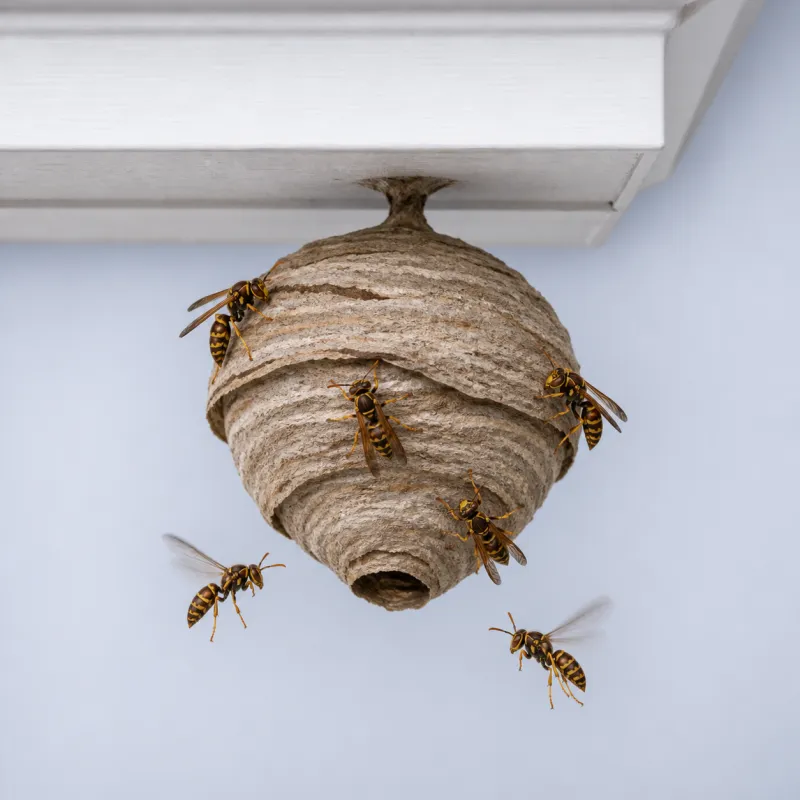
| Paper wasp | Open umbrella comb under eaves and ledges, behind shutters, inside porch lights, grills and mailboxes | Moderate. Not very aggressive, but stings when a hidden nest gets bumped |
| Yellowjacket | Underground in old rodent burrows, under rocks and landscape timbers; also wall voids and attics | High. Unpredictable, defends the nest as a group, worst in late summer |
| Bald faced hornet | Large gray football shaped nest in a tree or on a wall, often hidden in dense canopy | High. Hundreds of wasps, extremely aggressive when disturbed |
| Mud dauber | Mud tubes or organ pipe rows on sheltered walls, porch ceilings, garages and barns | Low. Solitary, does not defend the nest, stings only if handled roughly |
| Cicada killer | Single burrows in bare sunny soil, with a fan of loose dirt at the opening | Low. Alarming size, no colony to defend, males cannot sting at all |
The two that scare people and should not
Cicada killers are the biggest wasps most Oklahomans ever see and among the least dangerous. Females run an inch and a half to nearly two inches, and the males that hover at eye level to size you up have no stinger at all. University of Kentucky extension entomologists note these wasps are solitary rather than social, so there is no colony to defend, and stings essentially only happen when someone steps on or grabs one. They are most visible in July and August, digging 12 to 15 inch tunnels in dry bare soil, and control is usually unnecessary. Since 2020 they get reported as murder hornets constantly, which the same source settles: the Asian giant hornet is not known to occur outside the Pacific Northwest.
Mud daubers earn even less concern. They are solitary wasps that build the mud tubes and organ pipe rows under porch ceilings, and the Missouri Department of Conservation notes they do not defend their nests the way paper wasps and yellowjackets do, stinging only if handled roughly. They stock those cells with spiders, and the blue mud dauber specializes in black widows. Knock the nests down if they bother you, but know you are evicting a spider trapper.
Late summer is yellowjacket season for a reason
Yellowjackets get aggressive in August and September because the colony has hit maturity and the food supply changed. University of Kentucky extension entomologists explain that huge numbers of workers forage for the developing queens while insect prey runs short, so they scavenge instead: soda, fruit, barbecue, trash cans. That is why a July backyard is fine and the same yard in September is a running battle.
Practical handling for the foraging season. Keep food and drinks covered until you eat, clean spills fast, and use trash cans with tight self closing lids set away from where people sit. Do not swat, since most stings happen when a forager gets slapped or trapped against skin. Be careful drinking from a can outdoors, because a sting inside the mouth is especially dangerous. Garden center traps capture plenty of wasps and rarely dent a colony of thousands, and if you use them, place them at the edge of the area you want to protect.
For the full story on why the same yard turns hostile every September, and the five signs a nest is past self-treatment, read our guide to why yellowjackets turn mean in late summer in Oklahoma.
Why ground and wall nests are the ones to hand off
An accessible paper wasp nest is a reasonable do it yourself job, and a ground or wall void yellowjacket nest is not. University of Kentucky guidance is clear on the difference. Paper wasp nests can be treated in daylight with a store aerosol that sprays twenty feet, as long as you do not stand under the nest, then knocked down a few days later.
Ground and void nests change the math. They need insecticide dust rather than aerosol, because dust penetrates deep burrows and wall cavities a spray never reaches, and they must be treated at night while the colony is inside and sluggish. Approach slowly, never shine the flashlight into the entrance, and set the light on the ground off to one side. Two mistakes cause the worst outcomes: dousing a nest with gasoline or a hose, which seldom works and reliably earns multiple stings, and sealing the entry hole on a nest behind siding, which sends the wasps chewing inward until they emerge indoors.
Stings: what is normal and what is an emergency
Most stings produce pain, redness, itching and local swelling that an ice pack and an over the counter antihistamine will handle, and washing the site with soap and water reduces infection risk. That is the ordinary outcome and needs no doctor.
Call 911 immediately if a sting is followed by difficulty breathing or swallowing, swelling of the face, throat or mouth, widespread hives or itching, dizziness, a racing pulse or faintness. University of Kentucky entomologists note that roughly one percent of the population, about two million Americans, is hypersensitive to the venom, and that anaphylaxis can be fatal within minutes, so waiting to see whether symptoms pass is the wrong move. Anyone who has had a serious reaction before should carry an epinephrine auto injector, use it at once, and still go to an emergency room afterward. For anything short of airway symptoms, the Oklahoma Center for Poison and Drug Information answers around the clock at 1-800-222-1222 and will tell you whether the sting needs to be seen.
How wasp removal in Tulsa is priced
These are ranges commonly seen across the Tulsa metro, not quotes. Access drives the price more than species, since a nest you can reach from the ground is a different job from one behind second story siding.
- Accessible paper wasp nest under an eave or in a grill: roughly $100 to $175.
- Yellowjacket ground nest: roughly $150 to $300, usually with a return check.
- Wall void or soffit nest needing dusting and access work: roughly $250 to $500.
- Bald faced hornet nest high in a tree, needing pole equipment: roughly $200 to $450.
- Included with an existing quarterly plan: often at no extra charge, so ask.
One Oklahoma note. If the insects are honey bees rather than wasps, that is a different job, and the Oklahoma Department of Agriculture, Food and Forestry keeps a list of certified pest control operators who respond to bee calls. Every pest control business and applicator in the state is licensed through that same department. The companies in our network are independent and licensed, and calls route by ZIP code across Tulsa, Broken Arrow and Claremore. Booking a yard visit anyway? Ask about mosquito control too.
How the call works
- Describe the problem. A recluse in a shoe, termite swarmers on a window sill, ticks coming in on the dog. A sentence or two is plenty.
- Get routed by ZIP code. The call lands with an independent, licensed company that already services your neighborhood, whether that is midtown Tulsa or Claremore.
- Set the appointment. Most companies can give you an inspection or treatment window before you hang up.
Whether a same-day or 24/7 visit is possible comes down to provider participation in your area, technician availability and demand on that day. It is never guaranteed, and open slots vary by market and by how full the schedule already is.
Frequently asked questions
How much does wasp nest removal cost in Tulsa?
An accessible paper wasp nest typically runs roughly $100 to $175, a yellowjacket ground nest roughly $150 to $300, and a wall void or soffit nest roughly $250 to $500 because it needs dusting and sometimes access work. Those are typical Tulsa market ranges rather than quotes. Height and access drive the price more than species.
Why are yellowjackets so aggressive in late summer?
The colony peaks in late summer and early fall, when huge numbers of workers are foraging for developing queens and natural insect prey has thinned out. They switch to scavenging sweets, meat and trash, which puts them where people eat. Nest defense also intensifies, so a mower or a footstep near a ground nest triggers a group response.
Are cicada killer wasps dangerous?
Not really, despite being nearly two inches long. They are solitary wasps with no colony to defend, males have no stinger at all, and females sting essentially only when stepped on or grabbed. They dig burrows in bare, sunny, well drained soil in July and August. Control is rarely necessary, and they are often mistaken for hornets.
Can I remove a yellowjacket ground nest myself?
It is the one nest most people should hand off. Ground and wall nests need insecticide dust applied at night rather than an aerosol, and mistakes go badly fast. Never pour gasoline on a nest or flood it with a hose, and never seal the entry hole on a nest behind siding, because the wasps will chew inward and emerge indoors.