
The farm history is not decoration
Bixby's agriculture explains its pest pressure better than any map. The town incorporated in 1906 with 400 residents, named for Tams Bixby of the Dawes Commission, and by 1941 it had become a regional rail shipping point for cantaloupes, potatoes, radishes, squash, turnips, spinach and sweet corn. That earned the Garden Spot of Oklahoma name, and it stuck.
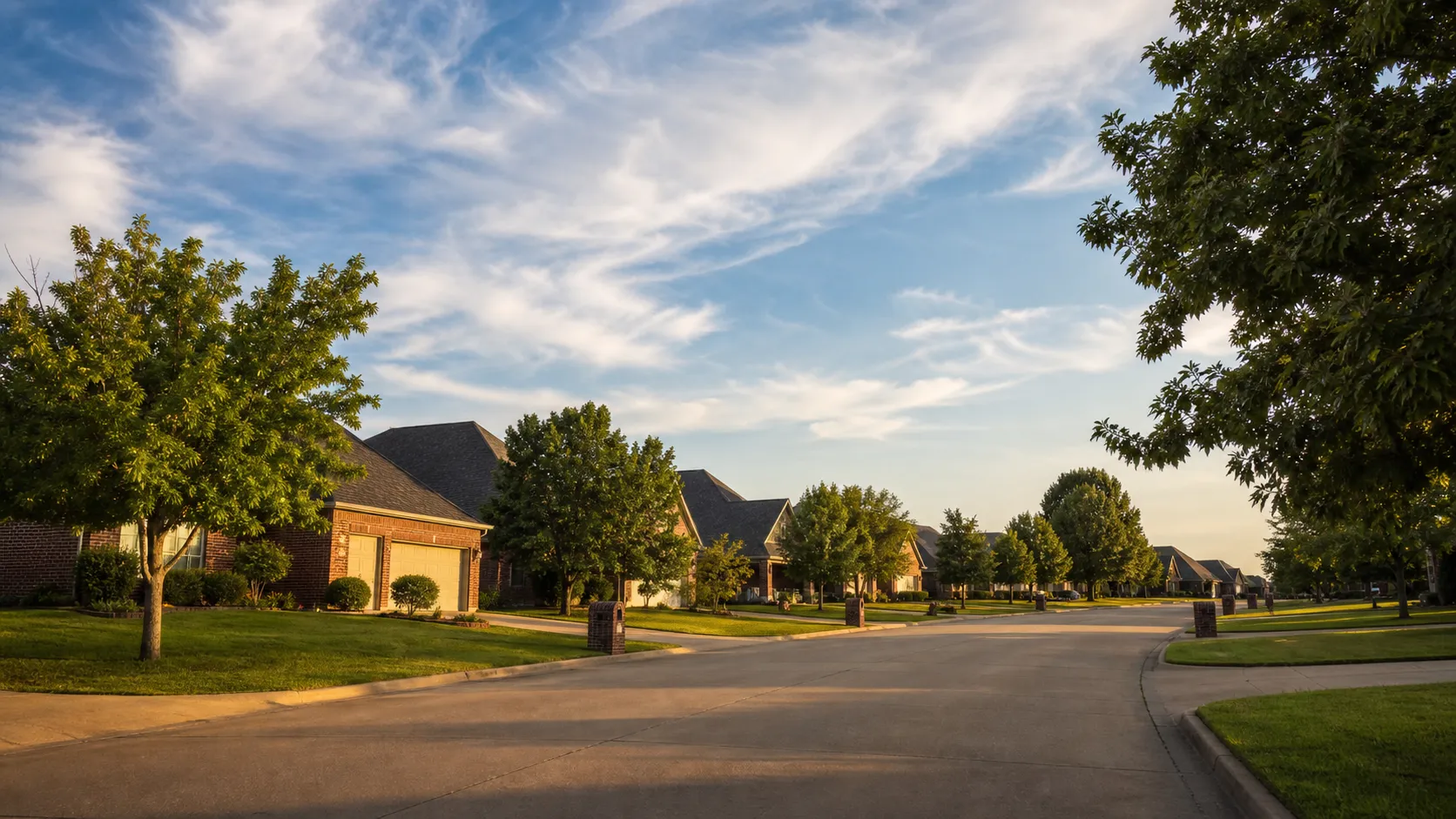
Most of those truck farms later converted to sod production, mostly Bermuda grass, which means the ground around town is still irrigated, still mowed on a schedule and still full of insects. Meanwhile the population went from 20,884 in 2010 to 28,609 in 2020, a 37 percent jump on top of 57 percent the decade before, spread over 26.76 square miles of Tulsa and Wagoner counties. New large-lot subdivisions now share fence lines with working fields.
That fence line is the whole interface. A back yard that ends at a sod field or a bean row inherits whatever is living in it.
Bottom land holds water, and water holds mosquitoes
The Arkansas River splits Bixby into north and south halves, with the original town center on the south bank, and elevation across the city runs a low 600 to 750 feet. Bottom ground drains slowly, and slow drainage is the entire mosquito equation.
Culex mosquitoes, the group that carries West Nile virus, breed in anything that holds water for a week and peak across the United States from July into October. In Bixby the water is rarely a pond. It is an irrigation riser puddle, a tailwater ditch, a low corner of a two-acre lawn, a tarped boat, a clogged gutter. Fixing those beats spraying them.
- Irrigation riser puddles and tailwater ditches at the field edge
- Low corners of a two-acre lawn that stay soft for days after a storm
- Tarped boats, wheelbarrows, plant saucers and clogged gutters
- Livestock and pet water that nobody dumps
- French drains and downspout extensions that hold water instead of shedding it
Walking that list once a week beats any single treatment on the schedule.

The Bixby short list
Five pests account for most local calls, and four of them trace back to irrigated ground.
| Pest | Why Bixby feeds it | What actually works |
|---|---|---|
| Mosquitoes | Irrigated sod ground and slow-draining river bottom | Barrier treatment plus weekly water dumping |
| Field and house mice | Crop and sod edges pressed against large lots | Sealing garage and utility penetrations |
| Odorous house ants | Irrigation keeps soil damp against slab edges all season | Non-repellent exterior band plus interior baits |
| Subterranean termites | Wet bottom soil holding against foundations and porch pours | Liquid barrier or in-ground bait system |
| Brown recluse | Barns, shops and outbuildings on acreage lots | Glue boards, sealing, clutter reduction |
Notice what is not on the list. Bixby generates fewer cockroach and bed bug calls per household than the older, denser midtown Tulsa housing stock. What it produces instead is outdoor pressure that never really stops, which is why annual plans here lean on exterior work and yard treatments rather than heavy interior service.
What pest control in Bixby costs on a large lot
Lot size drives the bill here more than house size, because mosquito, tick and rodent work is measured by ground covered. These are typical ranges in the Tulsa market, not quotes.
| Service | Typical local range |
|---|---|
| Initial general pest service | $160 to $320 |
| Quarterly plan | $105 to $180 per visit |
| Mosquito barrier, standard yard | $70 to $120 per application |
| Mosquito barrier, an acre or more | $120 to $220 per application |
| Liquid termite barrier | $1,300 to $3,200 |
| Rodent exclusion including outbuildings | $300 to $700 |
Bixby's per capita income of $36,257 is the highest in the Tulsa metro, which does push some quotes up. Ask what the price covers in square feet or acres before you agree to it.
North of the river, south of the river
Calls are routed by ZIP code, which matters in a town the river divides across two counties. Tulsa Pest Partners is an independent referral service: we do not treat property, we connect you with a licensed local company that already covers your side of the water.
Ask any company for its Oklahoma license before scheduling. Applicator licensing runs through the Oklahoma Department of Agriculture, Food and Forestry, which also publishes the ODAFF-1, the state's official termite and wood destroying insect report. Pricing here sits close to Jenks just upriver.
Ask whether the quoted plan includes outbuildings. The shop, the barn and the detached garage are usually where the spiders and rodents actually live, and a surprising number of quarterly plans stop at the house wall.
How the call works
- Describe the problem. A recluse in a shoe, termite swarmers on a window sill, ticks coming in on the dog. A sentence or two is plenty.
- Get routed by ZIP code. The call lands with an independent, licensed company that already services your neighborhood, whether that is midtown Tulsa or Claremore.
- Set the appointment. Most companies can give you an inspection or treatment window before you hang up.
Whether a same-day or 24/7 visit is possible comes down to provider participation in your area, technician availability and demand on that day. It is never guaranteed, and open slots vary by market and by how full the schedule already is.
Frequently asked questions
Why are mosquitoes worse in Bixby than in north Tulsa?
Elevation and irrigation. Bixby sits low against the Arkansas River, between 600 and 750 feet, so water sheds slowly, and the surrounding sod and crop ground is watered on a schedule all summer. That combination gives Culex mosquitoes far more breeding sites than a well-drained lot on higher ground north of town.
Do the sod farms push pests into Bixby neighborhoods?
Indirectly, yes. Irrigated turf holds moisture and insects, and every mowing or harvest disturbs whatever is living there. Field mice, ants and mosquitoes move to the nearest stable shelter, which is often a house on the fence line. A treated exterior band and sealed entry points handle most of that traffic.
How much does an exterminator in Bixby charge?
General pest service in Bixby usually runs $160 to $320 for the initial visit and $105 to $180 quarterly. Yard treatments price by acreage, so a two-acre lot costs meaningfully more than a quarter-acre one. Those are typical ranges across the Tulsa market rather than a quote for your property.
Are termites a bigger risk on Bixby river bottom ground?
Moisture is the risk factor, and bottom land holds it. Eastern subterranean termites forage from soil and follow damp conditions along foundations, porch pours and expansion joints. Grading that carries water away from the house, working downspouts and an annual inspection matter more on low ground than almost anywhere else in the metro.