
The short answer: a full colony and an empty pantry
Yellowjackets in Oklahoma turn mean in late summer because the colony is at its largest right when its natural food runs thin. Oklahoma State University Extension says yellowjacket populations peak in the fall, and a mature southern or eastern yellowjacket colony can hold 1,000 to 5,000 adults. That is a lot of mouths.
Through June and July those workers mostly hunt live insects. By August the colony is raising next year's queens, and the workers go looking for sugar and protein wherever they can find it: the soda can on the patio rail, the brisket on the smoker, the plums rotting under the neighbor's tree. They are not angrier as individuals. There are just far more of them, they are hungrier, and they are in your space.
What one ignored nest looks like by September
A yellowjacket nest you noticed in July and decided to leave alone is a much bigger problem by Labor Day, and it usually announces itself at the worst moment.
Picture a Saturday in early September. It is ninety-something, the grass along the back fence finally needs cutting, and you have mowed over that same bald patch a dozen times this summer. This time the mower wheel rolls straight across a thumb-sized hole. You feel it before you understand it: a hot needle on the ankle, then the wrist, then the back of the neck. OSU Extension warns that you will almost certainly be stung if a mower or trimmer runs near a yellowjacket nest, and that in some species a stinging worker releases an alarm chemical that pulls its nestmates into the attack.
Unlike a honey bee, a yellowjacket keeps its stinger and can use it again and again. So the running is the right call, and OSU says exactly that: once a nest is disturbed, leave fast. You will still be counting welts at the kitchen sink.
The quieter version is worse. A nest inside the wall behind the siding keeps growing all summer, and one warm afternoon there is a slow, steady trickle of yellowjackets on the inside of the bedroom window. That is the colony finding its way in rather than out.
Where yellowjackets nest around a Tulsa house
Yellowjackets around Tulsa homes nest mostly in the ground or inside enclosed spaces, which is why people find them by stepping on them. OSU Extension lists three yellowjacket species in Oklahoma, the southern yellowjacket, the eastern yellowjacket and the baldfaced hornet, and says most build in underground or enclosed sites such as wall voids, attics and hollow logs.
Walk your yard with this list and watch for a steady stream of wasps flying in and out of one spot in a straight line. That traffic pattern is the giveaway.
| Where to look | What it looks like | Risk level |
|---|---|---|
| Lawn edges, fence lines, under shrubs | A small hole in the ground with constant traffic, often an old rodent burrow | High for whoever mows or trims there |
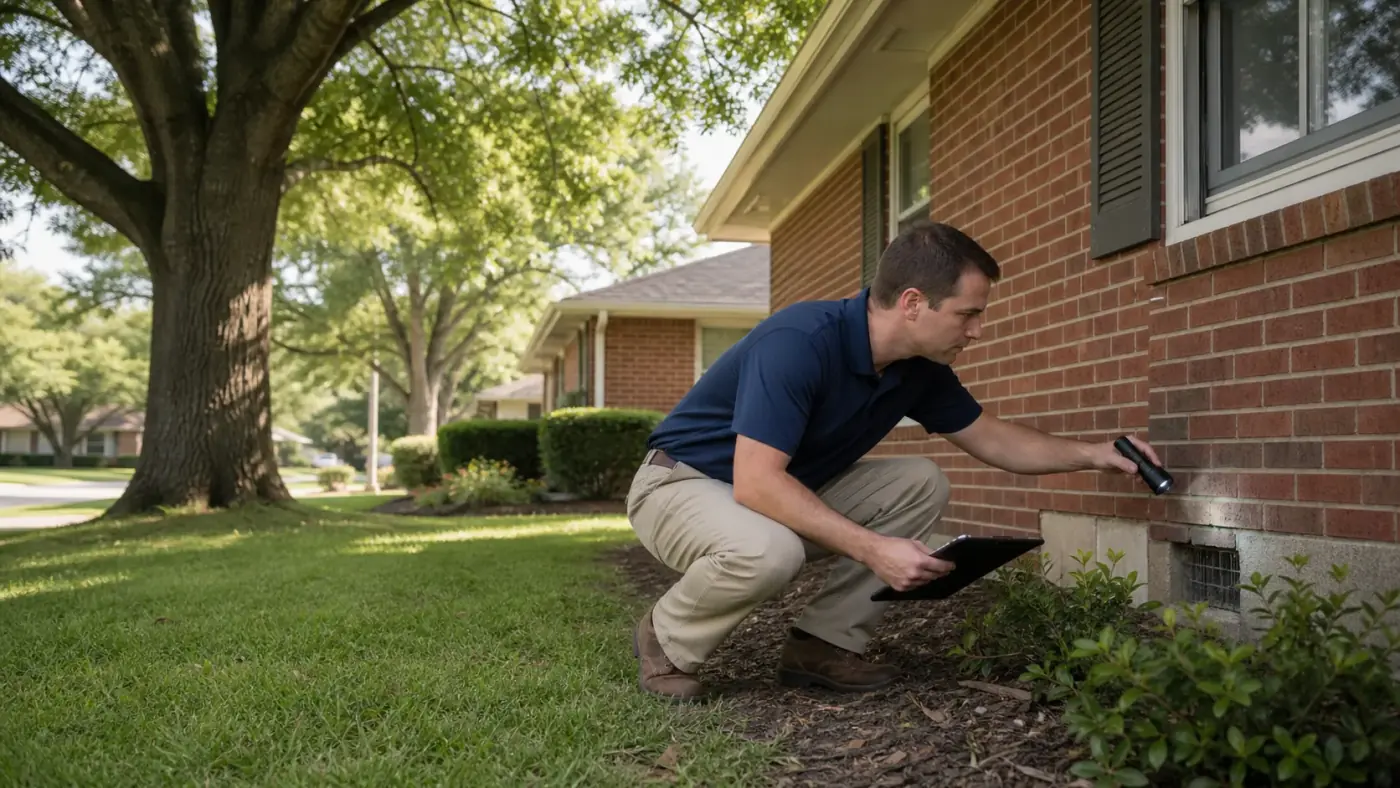
| Siding gaps, soffits, brick weep holes | Wasps disappearing into a crack in the house wall | High, the nest can grow into the living space |
| Attic vents and roof returns | Traffic at a gable vent, faint rustling overhead | High, hard to reach safely |
| Railroad ties, landscape timbers, stumps | Wasps working a rotten spot or a gap under the timber | Medium |
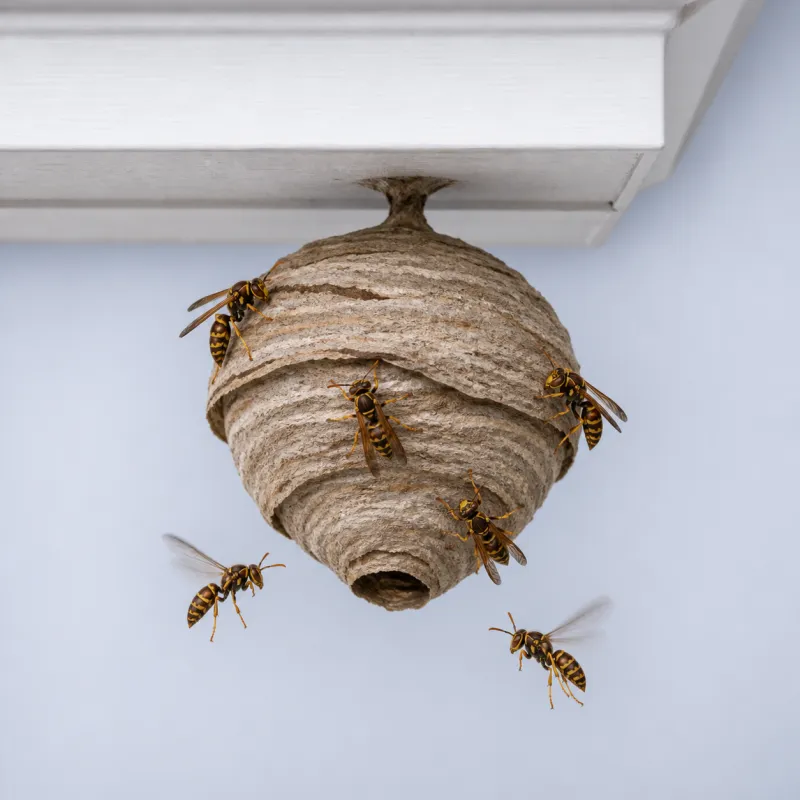
| Trees and eaves, gray papery ball | A football-sized nest in the open, usually baldfaced hornets | Medium, leave it unless it sits by a door |
Paper wasps with a small open comb under the porch light are a different animal and a much milder one. Our wasp removal page breaks down how to tell them apart.
What you can safely do yourself
You can do a lot to cut yellowjacket run-ins on your own, and most of it is about taking away the buffet rather than fighting the colony. These steps come straight from OSU's avoidance advice plus what works in a real backyard.
- Lid the trash, rinse the cans. Tight-fitting lids, emptied often in the fall. OSU suggests washing empty cans with an ammonia solution to cut the food smell.
- Pour your drink into a cup with a lid. A yellowjacket inside a soda can is how people get stung in the mouth and throat, which OSU flags as especially dangerous.
- Pick up fallen fruit and clear plates fast. Pears, figs and plums on the ground are a yellowjacket magnet in September.
- Dress boring. OSU says tan, khaki and dark clothes attract fewer wasps than bright yellow, orange or blue, and to skip the perfume and sweet hair spray outdoors.
- Do not swat. Stay still or move away slowly. Swatting is how a curious forager becomes a sting.
- Flag the nest and change your route. Put a stake near the hole, keep kids and dogs clear, and mow around it until it is dealt with.
A few honest notes on what does not work. OSU does not recommend the garden-center traps, because the common ones are not effective against Oklahoma's species and the sugar-water kind catch honey bees too. Gasoline, a garden hose and a bucket of boiling water are all bad plans. And do not plug a hole in your siding while the colony is still alive, because the workers will chew in the other direction.
When DIY is not enough: five signs
A yellowjacket nest is past DIY once it is big, hidden or close to people who cannot run, and OSU Extension itself says to seek professional help for large nests and nests in wall voids or attics. Here are the five signs.
- The nest is in a wall, soffit or attic. Structural nests need dusting equipment and follow-up, and a mistake sends wasps indoors.
- Yellowjackets are showing up inside the house, on windows, in a light fixture or around a vent.
- Someone in the home has had a serious sting reaction before, or you are not sure, and the nest sits by a door, a play set or the dog run.
- The traffic is heavy, dozens of wasps a minute at the entrance, which means a colony in the thousands.
- You have already tried and been stung, or the nest is up a ladder where one sting could mean a fall.
If any of those sound like your yard, call (844) 212-9836 and tell us where the nest is and how busy it looks. We connect you with a licensed local provider who works your part of Green Country and treats ground and wall nests with the right gear, usually after dark when the whole colony is home. Typical market ranges, not a quote, run about $150 to $300 for a ground nest and $250 to $500 for a nest inside a wall or soffit.
After the nest is gone
A treated yellowjacket nest does not come back, because the colony is annual and the next spring's queens start somewhere new. OSU Extension says yellowjackets usually stay active from September into early December, then cold weather finishes the season and only mated queens survive the winter in sheltered spots.
That means the real prevention happens in May and June, when a single queen is building a golf-ball-sized starter nest. Walk the fence line and check the siding once a month in early summer, and a problem that takes a pro in September takes a can of wasp spray in June. If you want the whole yard covered, the Tulsa pest control overview explains how seasonal plans handle wasps along with everything else, and our pest control cost guide has the rest of the numbers.
And the good news, honestly, is that this is the most seasonal pest in Oklahoma. Get through October, and the yard is yours again.
How the call works
- Describe the problem. A recluse in a shoe, termite swarmers on a window sill, ticks coming in on the dog. A sentence or two is plenty.
- Get routed by ZIP code. The call lands with an independent, licensed company that already services your neighborhood, whether that is midtown Tulsa or Claremore.
- Set the appointment. Most companies can give you an inspection or treatment window before you hang up.
Whether a same-day or 24/7 visit is possible comes down to provider participation in your area, technician availability and demand on that day. It is never guaranteed, and open slots vary by market and by how full the schedule already is.
Frequently asked questions
Why are yellowjackets so aggressive in late summer?
Yellowjackets get aggressive in late summer because the colony is at its biggest and hungriest. Oklahoma State University Extension notes yellowjacket populations peak in the fall, and the workers start scavenging for sugar and protein at trash cans, fallen fruit and picnic tables, which puts thousands of defensive insects right where people eat.
How many yellowjackets are in a ground nest in Oklahoma?
A mature southern or eastern yellowjacket colony in Oklahoma holds roughly 1,000 to 5,000 adults, according to Oklahoma State University Extension. Most of that colony is underground or inside a wall, so the handful of wasps you see at the entrance is a small fraction of what is inside.
Should you pour gasoline or water into a yellowjacket nest?
No, pouring gasoline or water into a yellowjacket nest is a bad idea. Gasoline is a fire and groundwater hazard, and a hose rarely reaches the combs, so both mostly produce an angry colony and multiple stings. Oklahoma State University Extension recommends treating ground nests after dark, and handing off large nests and nests in wall voids or attics to a professional.