
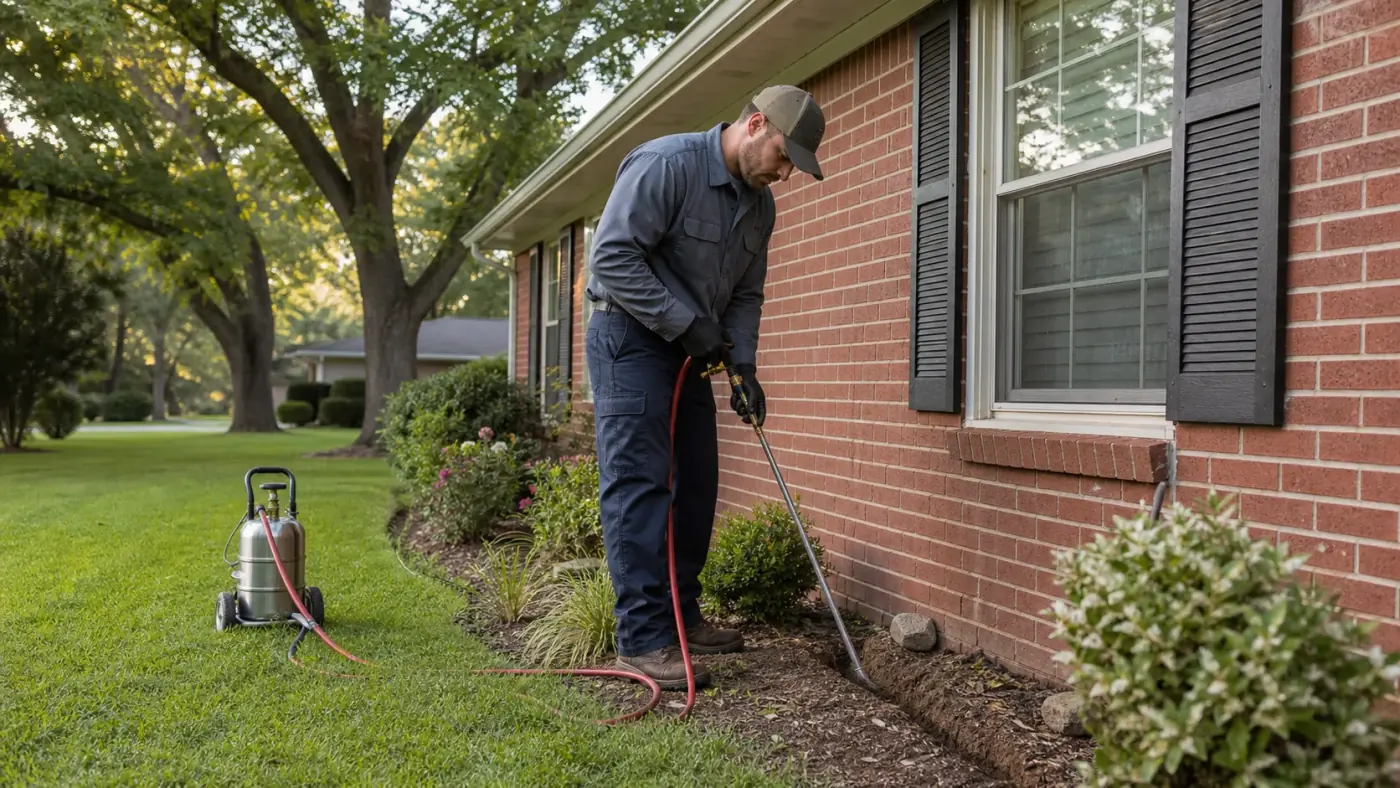

What a termite swarm in Oklahoma is telling you
A termite swarm in Oklahoma is a mature subterranean colony sending out its winged kings and queens, and Oklahoma State University Extension lists March, April and May as the normal flight months. The flights go off on warm days, usually mid-morning to mid-afternoon, and very often right after a spring rain has soaked the ground. OSU has also recorded Oklahoma swarmers in every month of the year, so wings on the sill in September are not your imagination.
Termite swarmers themselves are harmless and a little pathetic: two fifths to half an inch long, dark brown to black, and terrible fliers. Each one flutters a few yards, drops and twists its wings off, which is why the usual evidence is a drift of clear wings on a sill or around a floor vent.
Where the swarmers came out is the whole story. OSU Extension is careful on this point: termites seen outdoors may have flown from soil in the yard, an old stump or the woodpile, not from your house. Indoors is a different conversation. Mississippi State University Extension calls swarmers inside a building a clear indication that the building is infested, and adds that a colony needs several years of growth before it can swarm at all.
What the colony does if you wait for next spring
A subterranean termite colony keeps eating long after the swarm is over, because Mississippi State Extension points out that termites swarm once a year but stay active 365 days a year. So picture sweeping up the wings, deciding they were flying ants, and forgetting about it.
Summer settles in. You are asleep down the hall, the AC is cycling, and a few feet from the bathroom sink, inside the wall where the supply lines run, pale workers are moving through the bottom plate in total darkness. They like that wall for the same reason OSU Extension tells you to check under sinks first: moisture. They eat along the grain and pack the empty galleries with soil, so from the outside the wood still looks like wood. Nothing creaks. Nothing smells.
Then one Saturday the vacuum nozzle punches through a baseboard like a saltine. Or the paint beside the tub starts to blister. Or the bedroom door that closed fine all winter begins to stick.
The money side is less cinematic and worse. Treatment is the smaller bill; replacing a sill plate or a run of subfloor is the larger one, and Bankrate's homeowners insurance guide notes that standard policies generally exclude termite damage as a maintenance problem. Sell the house later and the ODAFF-1 termite report puts that damage on paper in front of the buyer. That is the honest worst case in Green Country: not a house falling down, just years of quiet damage paid out of pocket.

Termite swarmer or flying ant? Three checks
Flying ants swarm in the same spring weeks as termites, and the OSU Plant Disease and Insect Diagnostic Laboratory fields a pile of look-alike questions every spring because of it. Drop one of your bugs on a white paper towel and check these three features, all taken from the OSU comparison:
| Feature | Termite swarmer | Flying ant |
|---|---|---|
| Antennae | Straight, like a string of beads | Bent at an elbow |
| Wings | Four wings, front and rear nearly equal in size and shape | Front wings much larger than the rear pair |
| Waist | As wide as the thorax, so the body looks like one tube | Sharply pinched between thorax and abdomen |
A pinched waist means ants, which is a nest to deal with but a much cheaper problem, and our page on ant control in Tulsa covers it. A straight waist and matching wings means termites. Keep reading.
What to do the day termite swarmers show up
The first day of a termite swarm is about collecting evidence and cutting off moisture, not about poison, because LSU AgCenter entomologists note that killing swarmers does little to protect a house from the colony behind them. Here is what genuinely helps:
- Save a sample. Sweep a dozen swarmers, or just a pinch of wings, into a zip bag and write down the room and the time. An inspector can confirm the species from that.
- Vacuum the rest. Skip the spray. Swarmers stuck indoors without soil generally die on their own, and spraying them never touches the workers in the wall.
- Find the exit point. Check window frames, tub access panels, door trim and floor registers, and mark the gap with painter's tape.
- Walk the foundation with a flashlight. OSU Extension describes termite mud tubes as a quarter to half an inch wide, built up the surface of foundation walls. Photograph any and leave them intact.
- Pull food and water away from the house. LSU AgCenter recommends keeping mulch 8 to 12 inches off the foundation, clearing wood and cardboard from around and under the home, fixing dripping outdoor faucets and leaking pipes, and grading soil so water drains away. Firewood stacked against the brick is an open invitation. When the swarm follows a big spring storm, our Oklahoma spring storm pest checklist covers the gutters, soffits and standing water in the same walk-around.
What you cannot do from a hardware store aisle is put a continuous termiticide barrier under a slab, which is why OSU Extension says termite work needs specialized equipment and professional experience.
When DIY is not enough: five signs to stop and call
A termite problem is past self-treatment once the evidence points at the structure instead of the yard, and OSU Extension states plainly that termites are persistent and will not go away on their own. If you see any of these, you are there:
- Swarmers or piles of wings indoors, especially on more than one day or in more than one room.
- Mud tubes on the foundation, on piers in a crawl space, or along the inside of the garage wall.
- Trim or baseboard that sounds hollow when tapped, or wood that crumbles to reveal packed soil inside.
- Blistering paint, a soft spot in the floor, or a newly sticking door near a tub, sink or water heater.
- You are buying or selling the house, or the warranty on an old termite treatment has lapsed.
If one of those matches what you are looking at, the sensible next step is an inspection, not a second can of spray. Call (844) 212-9836 and we connect you with a licensed local provider that handles termites in your part of the metro, whether that is midtown Tulsa or Broken Arrow. Tell them what you found and where, and hand the inspector that bag of wings.
What happens after the call, and what it tends to cost
A termite inspection in the Tulsa market typically runs about $75 to $150 and is often waived when the same company bids the treatment. A liquid termiticide barrier on an average home commonly lands around $900 to $2,200, and bait station systems run roughly $1,000 to $2,500 in the first year. These are typical market ranges, not a quote; the provider sets the price after measuring your foundation. Our termite treatment cost guide for Tulsa explains what moves that number, and the termite control page walks through how each method works.
Now the reassuring part, and it is not a sales line. Subterranean termite damage builds over years, not over a weekend, and a spring swarm is the colony giving away its location. Seeing the wings means you found out when the termites chose to show themselves, which beats finding out through the baseboard.
How the call works
- Describe the problem. A recluse in a shoe, termite swarmers on a window sill, ticks coming in on the dog. A sentence or two is plenty.
- Get routed by ZIP code. The call lands with an independent, licensed company that already services your neighborhood, whether that is midtown Tulsa or Claremore.
- Set the appointment. Most companies can give you an inspection or treatment window before you hang up.
Whether a same-day or 24/7 visit is possible comes down to provider participation in your area, technician availability and demand on that day. It is never guaranteed, and open slots vary by market and by how full the schedule already is.
Frequently asked questions
When is termite swarm season in Oklahoma?
Termite swarm season in Oklahoma normally runs March, April and May, according to Oklahoma State University Extension. Flights happen on warm days, usually between mid-morning and mid-afternoon, often after a spring rain. OSU also records Oklahoma swarmers in every month of the year, so a smaller fall flight is possible but far less predictable.
Do termite swarmers inside my house mean it is infested?
Swarmers emerging indoors are a strong sign the house itself is infested. Mississippi State University Extension calls indoor swarmers a clear indication of infestation, because a colony needs several years of growth before it produces swarmers at all. Swarmers seen only outdoors may have come from yard soil, a stump or a woodpile, so an inspection settles which case you have.
Should I spray termite swarmers with bug spray?
Spraying termite swarmers is mostly wasted effort. LSU AgCenter entomologists note that killing swarmers does little to protect a home from the colony that produced them, and swarmers stranded indoors usually die on their own. Vacuum them up, save a few in a sealed bag for identification, and put the money toward an inspection instead.
Does homeowners insurance cover termite damage?
Homeowners insurance generally does not cover termite damage. Bankrate's homeowners insurance guide explains that standard policies treat termite infestation as a preventable maintenance issue and exclude it, with narrow exceptions such as a covered fire caused by the damage. That exclusion is why catching a colony early, at the first swarm, saves real money.